What I build when an agency hires me to fix the whole operation.
Agency OS is not a product. It is the full engagement: four services, installed in the right order, so a growing agency can add revenue without adding chaos. You keep everything we build.
What it is
One engagement, four moving parts.
Most agencies between five and fifty people have the same four problems. Leads fall through the cracks. Work gets stuck on one person. Nobody trusts the pipeline report. And the only real playbook lives in the founder’s head.
You can try to solve those one at a time, and many do. The trouble is that each of them leaks into the others. Fixing lead intake without fixing delegation just means more drops hit the same bottleneck. Fixing the pipeline dashboard without fixing follow-up just tells you in higher resolution that leads are going cold.
Agency OS is the version where we fix all four, in the order that compounds. It is a 10 to 14 week engagement. You end up with a lead engine that does not forget, a delegation system that does not rely on you remembering who is good at what, a pipeline view everyone actually uses, and documentation the team can actually follow.
The four phases
Lead intake and follow-up.
We start here because it pays for the rest. Instant replies, smart qualification, follow-up that does not forget on day 2, day 5, and day 14. Most agencies recover the cost of the whole engagement from leads this catches in the first month.
See the service →Task routing and delegation.
New work comes in. Who picks it up, when, and with what context. We replace the “ping the founder in Slack” bottleneck with a system that routes tasks to the right person with everything they need to start, so you are not the blocker on your own team.
See the service →Pipeline visibility.
One view everyone trusts. Where every deal actually is, what is moving, what is stuck, and why. No more three people with three different numbers. The pipeline becomes the thing you run the Monday meeting from, not an argument about whose spreadsheet is right.
See the service →SOPs and documentation.
The last phase makes the first three stick. We capture how the work actually gets done, in a form your team can use on a Tuesday, so the business can run a week without you in it. This is also the phase that makes the business sellable, hirable into, or just less tiring.
See the service →Why this order
Revenue first, then time.
We start with lead intake because it is the phase that pays for itself fastest, usually inside 30 days. Once the top of the funnel is not leaking, the rest of the work feels less urgent and more strategic. You have time to fix delegation instead of firefighting.
Task routing goes second because it is the phase that frees your time. Once tasks route to the right person with context, the founder stops being the human router and starts being something more useful. That bought-back time is what makes phases three and four actually happen.
Pipeline visibility goes third because it depends on the first two being in place. A dashboard showing you that leads are cold and nobody picked them up is just a dashboard of bad news. Once intake and routing work, the pipeline becomes a decision tool.
Documentation goes last because you cannot write an SOP for a process that is still changing. By phase four, the way your business actually runs has stabilized. Now we capture it, so the next hire, the next week off, and the next market shift do not unravel everything we built.
What an engagement actually looks like
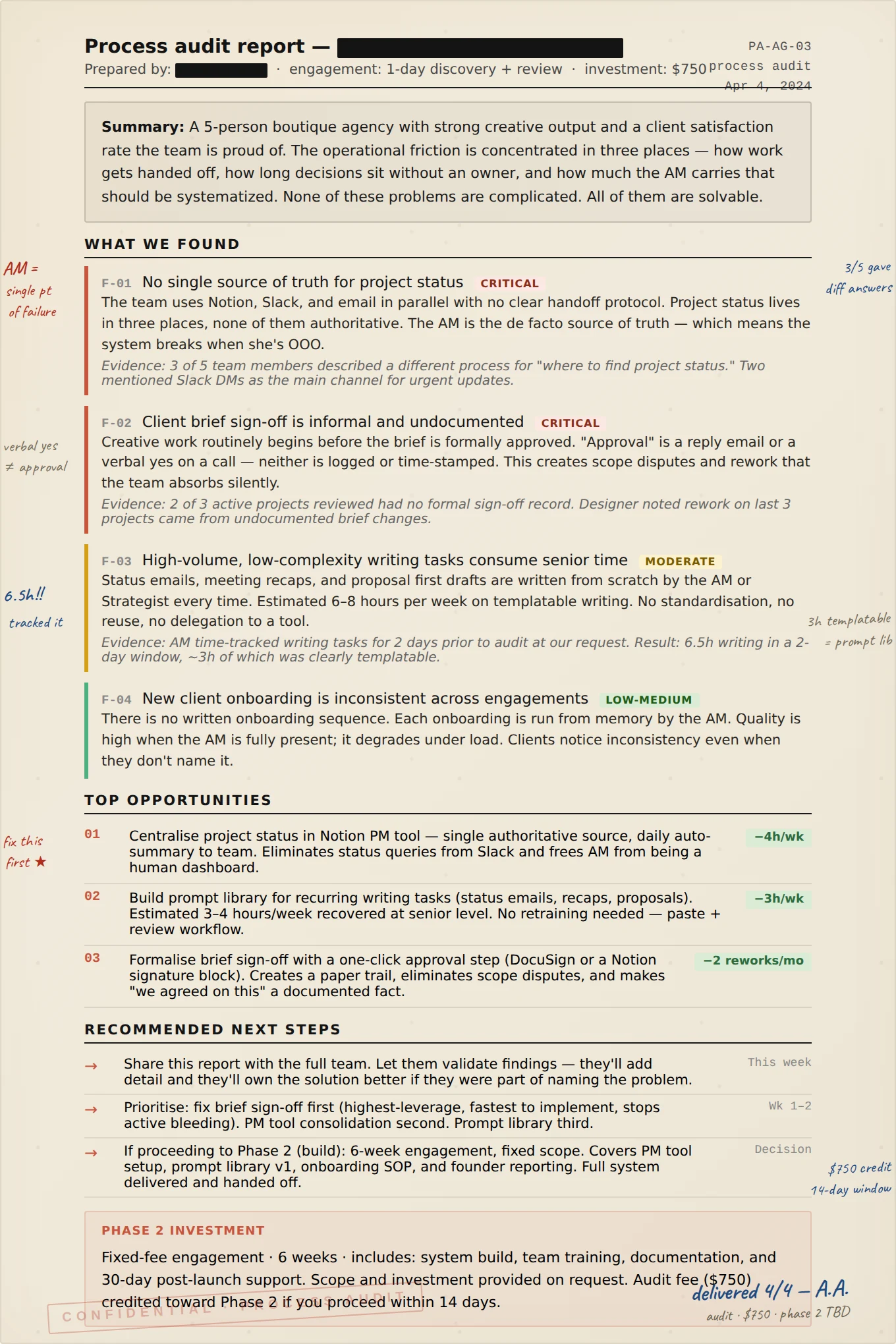
Phase one deliverable. A written report in plain language — what I found, how bad it is, what it would take to fix, and whether a full engagement makes sense for your business. Every claim has evidence attached. The cost of the audit is credited toward the build if you decide to proceed.
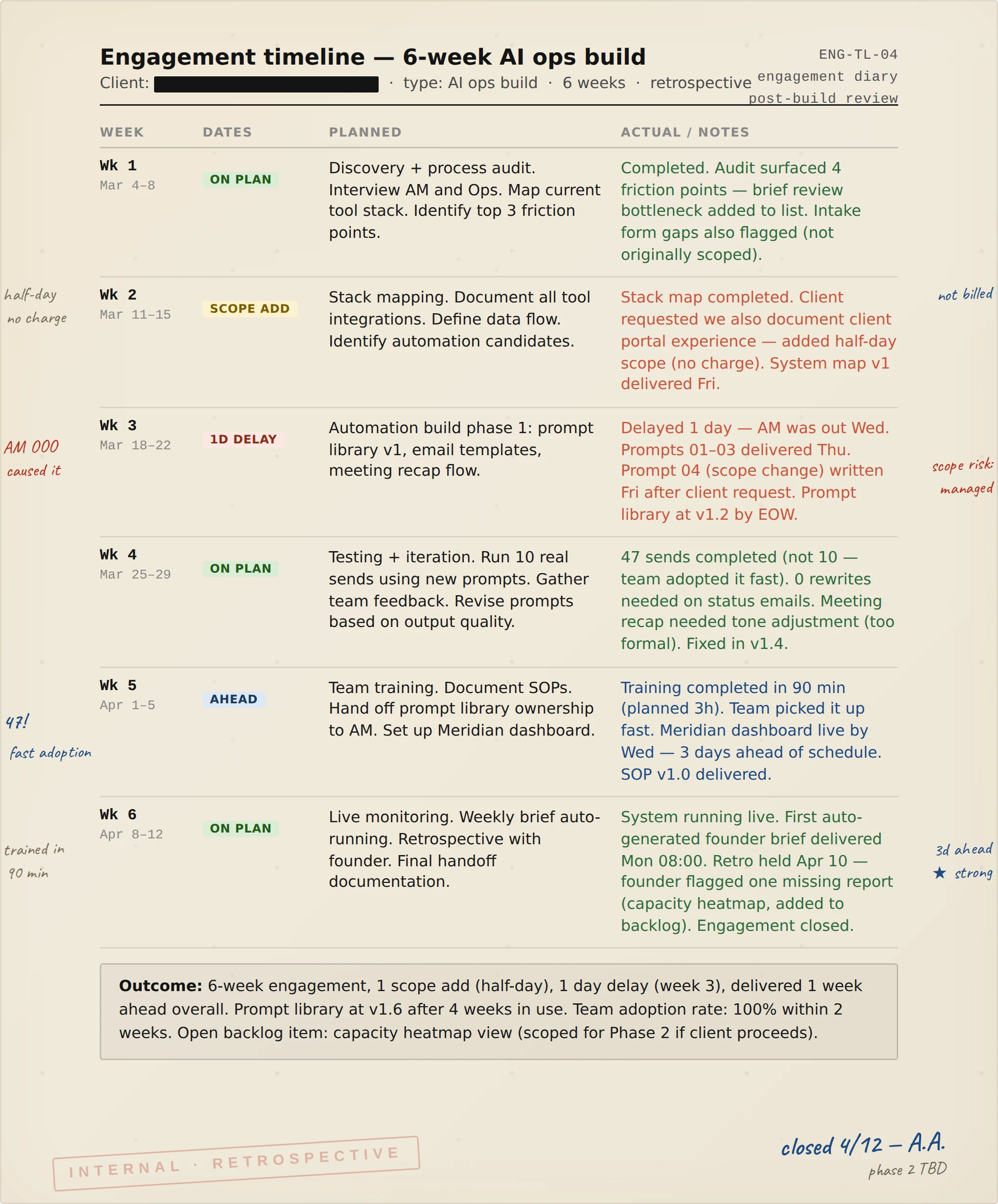
Six weeks, week by week. Every engagement ends with a retrospective like this — what shipped, what shifted, what the team learned. Transparency on the work beats a polished case study. If week three slipped a day, I write it down.
The math
Phase 01 typically recovers $30k to $80k a year in leads that used to go cold before someone replied.
Phase 02 returns 8 to 12 hours a week of founder time that used to go to routing and unblocking.
Phase 03 eliminates the Monday meeting that exists only because nobody trusts the pipeline.
Phase 04 turns the business from one that stops when you stop, into one that does not.
These are ranges, not guarantees. Every business is different. The diagnosis call is where we figure out which of these numbers is yours, and whether all four phases are even the right move.
How it works
Diagnosis.
A proper look at how your business actually operates right now. Where leads come in, who touches them, where work gets stuck, and which of the four phases would move the most revenue first. You see the map before we agree to anything.
Phase 01 build: lead intake and follow-up.
Fast, because this is the phase that funds the rest. By week 4 you are catching leads you used to lose, and the team is feeling the difference.
Phase 02 build: task routing.
With more leads converting, capacity gets tight fast. This is when we make sure new work flows to the right person without passing through your inbox first.
Phase 03 build: pipeline visibility.
One dashboard, one source of truth. We rebuild it around decisions you actually make, not metrics a CRM vendor decided you should care about.
Phase 04 build: SOPs and documentation.
We capture the way the business now runs. Short videos, one-page playbooks, checklists your team will actually open. The engagement ends with your operation documented, your team trained, and you holding the keys.
Handoff and 30-day check-in.
You own everything. Accounts, automations, documentation, the lot. A follow-up call a month later to tune anything that needs tuning and answer questions as they come up.
Who it’s for
A good fit if
- You run a service business between 5 and 50 people.
- Revenue is real, but the operation is held together by you.
- You have tried tools and templates, and you still end up in the middle of everything.
- You want the team to own this after, not depend on an outside agency forever.
- You would rather invest one quarter to fix the engine than spend another year firefighting.
Not a good fit if
- You are looking for a tool to buy, not an engagement to run.
- You want someone to run your operation for you indefinitely.
- You are pre-revenue or under 3 people. One of the single services is probably enough.
- You need compliance, regulated industry, or enterprise procurement work. Not my lane.
- You are hoping AI will replace your team. That is not what this is.
Common questions
Do I have to do all four phases?
No. Most engagements start with one or two services and only become Agency OS if the full picture makes sense after the diagnosis. If one phase is all you need, I will tell you.
Who actually does the work during the engagement?
I do, with your input. This is not a strategy deck with a “roadmap”. I design it, build it, write the copy, wire it up, and hand it over. You review and approve at each phase.
What tools do you bring in?
Wherever possible, what you already pay for. Microsoft 365 or Google Workspace, your CRM, your project tool, your calendar. New tools only when the existing one genuinely cannot do the job, and I will tell you before we start.
What happens after the 14 weeks?
You own everything. Most clients do not need ongoing work. Some keep a light retainer for tune-ups and new ideas. Either is fine.
How much does it cost?
It depends on scope and what the diagnosis finds. Fewer phases cost less. I quote the whole engagement up front, fixed fee, so there are no surprises. The diagnosis call is free.
Start with one conversation.
Twenty minutes. Tell me what is slowing the business down and I will tell you honestly whether the full engagement makes sense, whether a single service is enough, or whether you need someone else entirely.
Book the diagnosis call