The work in your business should not live in one person's head.
Most service businesses run on founder memory and Slack pings. I turn that into a system your team can actually run, so tasks move without anyone waiting on you for direction.
The problem
Why daily operations stall in service businesses
Here is the pattern I see every week. You know how your business runs because you have been running it for years. Your team knows their own jobs, but the connective tissue, the handoffs, the decisions, the who-owns-what, lives in your head.
So every day your team waits for you. Someone is not sure whether to respond to the client, or which project is the priority, or who is supposed to handle the thing that just came in. They ping you. You decide. You move on. They move on. Multiply that by five people, five days a week, and you are spending half your time being the operating system of your own company.
This is the most common reason growing service businesses plateau. Not lack of leads, not lack of talent. Lack of a system that lets work move without you.
What I set up
Clear ownership, documented.
Who does what, written down once. Not a forty-page manual. A single page per role that answers the question "if X happens, who handles it." Your team stops asking. You stop answering.
Automatic task routing.
New leads, client requests, support tickets, and internal tasks go to the right person automatically based on type, urgency, or team capacity. No more "who is handling the Henderson thing."
Status visibility without asking.
Every active piece of work has a state. You can see where things are without a standup, a Slack ping, or a check-in. Your team updates it as they work, not at the end of the day.
Escalation rules for when things stick.
If something has not moved in 48 hours, it flags. If a client has not heard from us in a week, it flags. You stop finding out about problems three weeks too late.
A daily and weekly rhythm.
Monday planning, end-of-day summaries, Friday retros, whatever fits your business. Documented, automated where possible, and consistent enough that your team runs it without you.
What this looks like
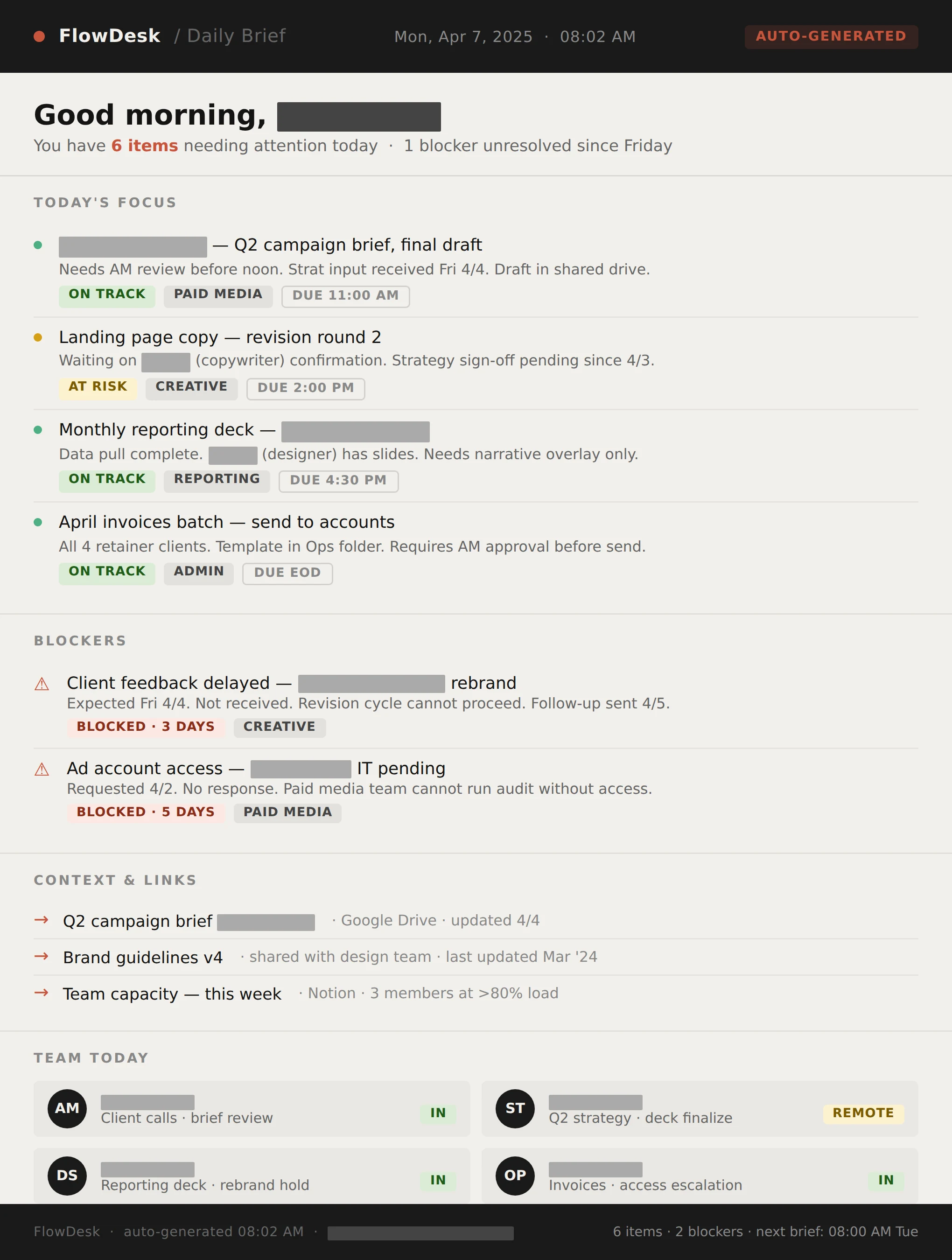
The team opens this before the first meeting. It pulls from Notion, Slack, and the CRM automatically — no morning stand-up required. Items are sorted by who owns what, what is blocked, and what context the team needs. If a founder is on the road, the brief goes to their phone.
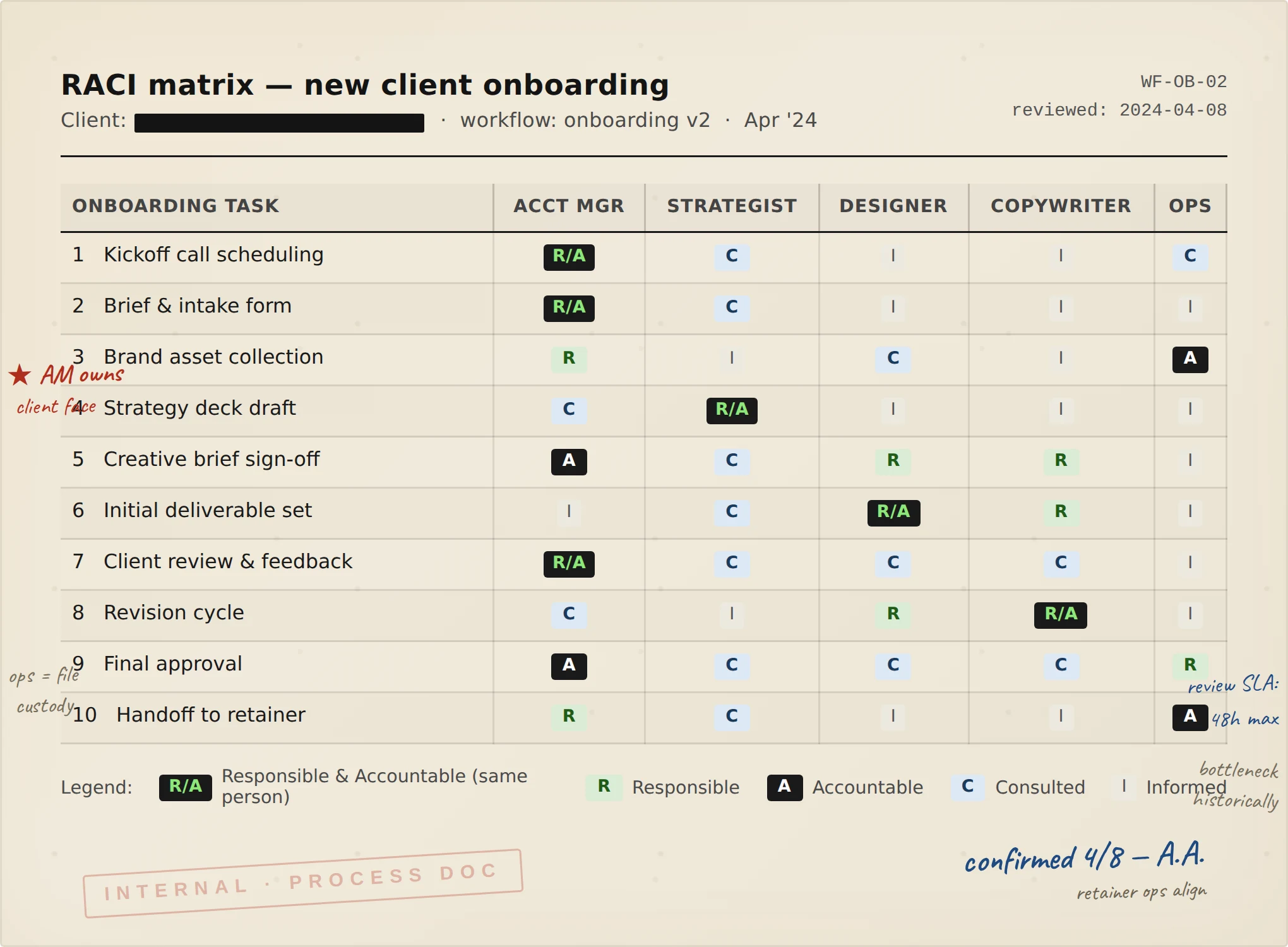
Ownership written down, once. Every recurring workflow gets a matrix like this so there is no ambiguity about who owns what. New hires read the matrix, not your head. Reviewed quarterly, adjusted when the team changes.
Tools I use
Whatever your team already uses
- Your existing project management (ClickUp, Asana, Notion, Monday, Linear)
- Your existing CRM and communication tools
- A lightweight automation layer (Zapier, Make, Power Automate, n8n)
- Existing spreadsheets and docs when they are genuinely the right tool
I will not ask you to change your project management tool. If what you have is wrong for the job, I will tell you, but most of the time the tool is fine and the workflows inside it are the problem.
How it works
Map the current flow.
I sit with you and your team and watch how work actually moves today. Where it starts, who touches it, where it waits, where it drops. I name every handoff and every bottleneck.
Design the new ownership.
I draft the new routing: who owns what, how work moves between roles, what the rules are when something is ambiguous. You review and approve before a single automation is built.
Build and document.
I set up the automation and write the role documentation in plain English. Each role gets one page. Each workflow gets one page. Nothing longer than a page unless it genuinely needs to be.
Team rollout.
I train your team live, not with a PDF. 30-day check-in to fix whatever broke and answer what came up. After that, it is yours.
The math
If your team is 5 people, each losing 45 minutes a day to "who is doing this" and "what is the status"...
That is 900 hours a year of recovered capacity across your team.
At a $50 per hour loaded cost, that is $45,000 of time either going back into billable work or going back into your evenings.
That is before we count the owner hours recovered from not being the default traffic cop. For most owners I work with, that number is bigger than the team capacity number.
Common questions
Do we need new software?
Usually not. Most service businesses already own a project management tool, a CRM, and a communication platform. The problem is the workflows inside them, not the tools themselves.
My team already pushes back on process. Will they resist this?
Teams resist process that makes their jobs harder. They welcome process that makes their jobs clearer. I build for the second, not the first. The rollout week is specifically about showing people how the new system saves them time, not adds steps.
What if our work is too custom to systematize?
Almost every business says this, and almost every business is wrong about it. There are usually ten or fifteen processes that run on repeat even in the most custom work. Those are what we systematize. The genuinely custom work stays custom.
How long until the team runs on its own?
The system is built to run independently from day one. In practice, it takes about 30 days for the team to stop defaulting back to old habits. I stay involved through that period.
Stop being the dispatcher for your own business.
Book a call. We look at how work actually moves in your business right now, and I tell you where the biggest time leak is. No pitch, no deck.
Book the call