N. 01
Plain language, always.
If a team cannot understand the system in normal conversation, the system is not ready. Documentation that requires a consultant to decode is not documentation — it is job security.
— N.iii. ABOUT · THE PERSON BEHIND THE WORK
Enterprise gets consultants. Smaller teams get software ads. Adela Ventures exists to close that gap — plain-language systems work for teams that need operations help now, not an enterprise roadmap six months from now.
My name is Adeola. I've spent the better part of a decade in enterprise technology — cloud architecture, AI engineering, IT leadership — watching well-funded organizations spend six figures to solve problems that a founder-led business would kill to have solved for six hundred dollars. I grew up around people who built things without infrastructure, who ran businesses on goodwill and spreadsheets because the tools that made enterprise companies run smoothly had never been pointed at them. That gap bothered me for a long time before I decided to do something about it.
Adela Ventures started in 2025, but the work it does is something I had been doing informally for years — helping people in my network figure out why their business felt harder to run than it should. At some point the pattern became undeniable: the smaller the business, the less likely it was to have anyone thinking about operations on its behalf. Not because the owners were not capable, but because nobody had offered them that kind of help at a price that made sense. This practice exists to change that.
The pattern I kept seeing, across every engagement, was that the smaller the organization, the larger the proportion of work nobody was officially responsible for. Contact lists that disagreed with each other. Intake forms that led nowhere. Vendors billing for tools nobody had opened in months. None of it was catastrophic. All of it was costing real time and real money. And none of it required enterprise resources to fix — just someone with the experience to see it clearly and the patience to fix it properly. That's the gap Adela Ventures fills.
N. 01
If a team cannot understand the system in normal conversation, the system is not ready. Documentation that requires a consultant to decode is not documentation — it is job security.
N. 02
Good operations work creates independence, not dependency. The best outcome of any engagement is that you go months without thinking about me. I will still be here when you do.
N. 03
Shiny tools lose to stable setups every time. The right answer is almost always a tool you have already paid for, configured in a way nobody bothered to think through.
N. 04
Buying first and deciding later is how stacks become expensive and brittle. I will not recommend a tool until I understand the problem it needs to solve — and I will always tell you if the answer is free.
N. 05
Accountability has to be clear when systems break under pressure. That is not a threat — it is how good work gets done. You should always know exactly who is responsible for what.
I started as a systems engineer. Then I ran operations. Then I ran the quiet, in-house technology that keeps a company working — the kind of role that doesn't have a good title because its best work is invisible. Big companies have teams for this. Small companies have the owner, at 11pm, on a Sunday, figuring it out alone.
The engagements that shaped this work most weren't the complex ones. They were the ones where a thirty-minute conversation surfaced a billing error three years old, or a two-week migration solved an intake problem the team had worked around so long they'd stopped seeing it as a problem. Small businesses don't need enterprise consultants. They need someone senior enough to know what's worth fixing, and honest enough to say when something isn't.
Founded Adela Ventures
Senior IT & Operations, mid-size US services firms
Cloud architecture + AI engineering, Microsoft-certified
Systems engineering, starting in enterprise software
Credentials and context
The certifications matter because they mean I know this stack at a senior level. They do not matter because certifications alone have never fixed a broken intake process. What fixes a broken intake process is someone sitting with you, watching how your business actually runs, and redesigning it with the tools that already exist.
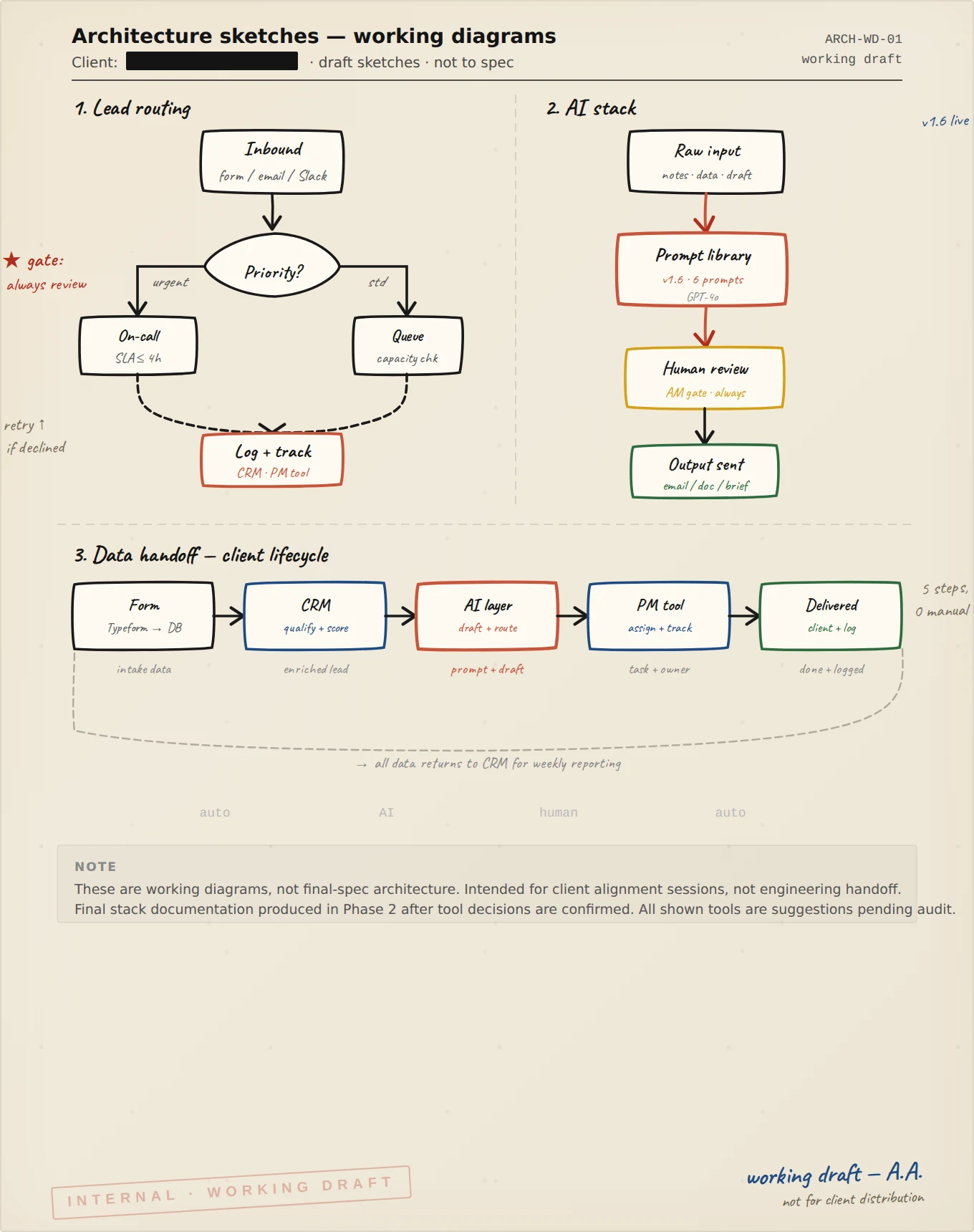
Drafted by hand, before anything gets built. Every engagement starts with sketches like these - lead routing, AI stack, data handoff - so the architecture is clear before the first line of configuration. Final stacks are documented for the client in Phase 2. These are working drawings, not presentation slides.
You'll get a useful read on where your bottleneck really sits, and a clear recommendation on what to fix first.