Your team should not have to ask you how to do their job every time.
Most small businesses run on what is in the owner's head. Every new hire starts from zero. Every time someone leaves, part of the business leaves with them. I write the things down, in plain English, and make them actually findable.
The problem
The business lives in your head
You have been doing this for years. You know how to onboard a client, how to quote a job, how to close the books at month-end, how to handle a difficult customer. All of that is in your head. Some of it is in your senior person's head. Almost none of it is written down.
So every new hire is trained by interrupting you. Every vacation is planned around whether the business can function without you for five days. Every time someone leaves, a piece of how the business works walks out the door.
The goal is not a binder nobody reads. The goal is a small set of documents, written the way you actually talk, findable in ten seconds, that answer the questions your team asks you over and over.
What I set up
The top 10 things, written first.
Not everything. Not 200 SOPs. I find the ten processes your team actually asks about most and we write those first. The rest can wait or never get written. Done is better than complete.
In human English, not corporate.
No "the stakeholder shall." No numbered sub-clauses. The way you would explain it to a new hire across a desk. Short sentences. Plain words. A few screenshots where they earn their place.
Findable in ten seconds.
One place your team goes. Search works. Titles are written the way people search ("how do I invoice a new client," not "Client Invoicing Protocol v2.1"). If it takes more than ten seconds to find, nobody uses it.
Checklists, not essays, where it matters.
Onboarding a client is a checklist. Closing the month is a checklist. Quoting a job is a checklist. Anything that is a sequence of steps becomes a tickable list, not three paragraphs of prose nobody reads.
A way to keep them alive.
Documents go stale the day they are written. I set up a simple quarterly review cadence, with clear ownership. No-one has to be the full-time "SOP person." Fifteen minutes a quarter, per document, is enough.
What this looks like
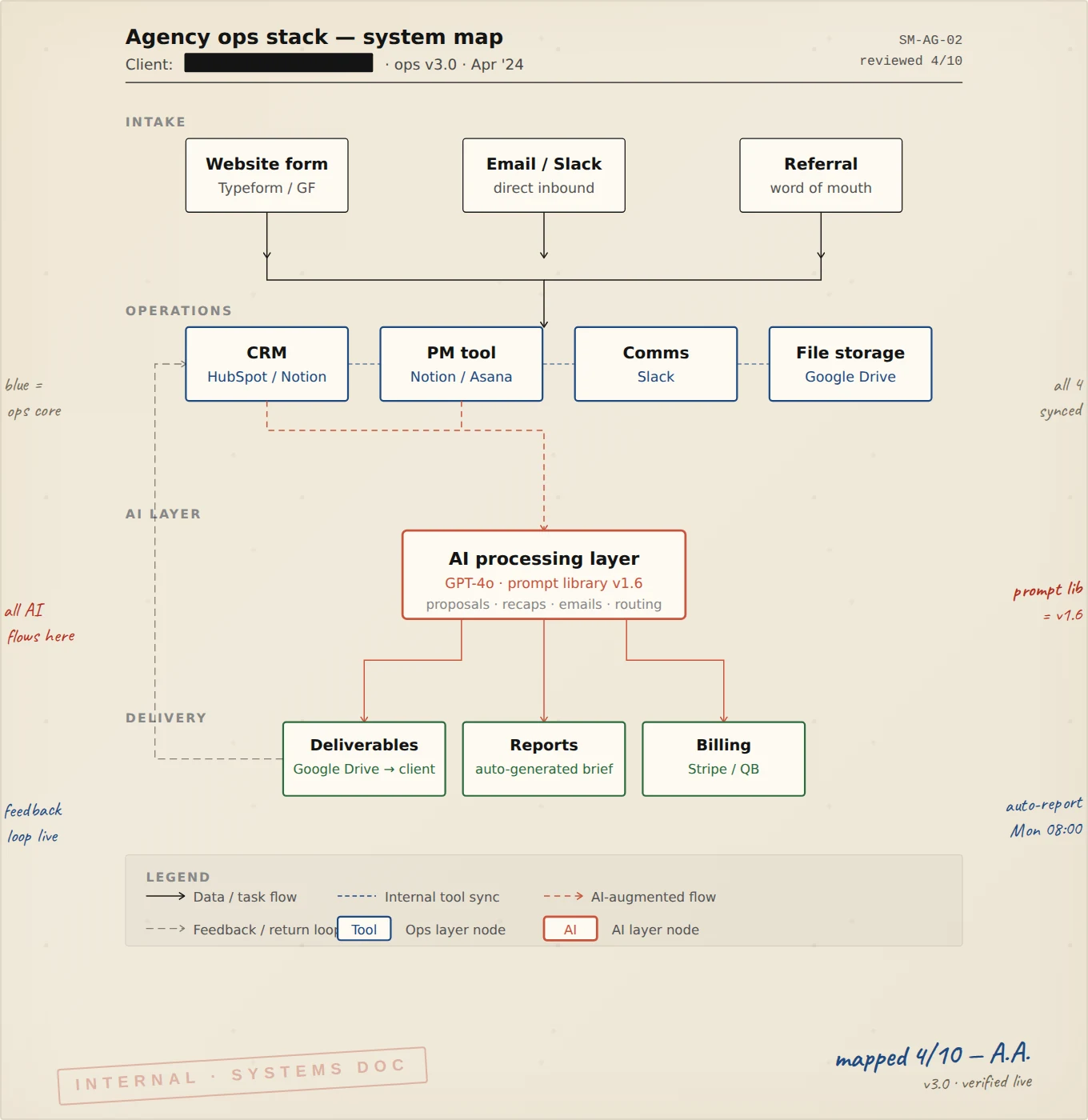
A one-page map the whole team understands. Every tool, every handoff, every place data flows. New hires read the map, not your head. Updated whenever something real changes — not quarterly, not in a binder, not in someone’s Notion that no one reads.
Tools I use
Whatever you already have
- Notion, Google Docs, SharePoint, Confluence — whichever your team is already in
- Loom or a phone recording for the things better shown than written
- A simple template so every document looks and reads the same way
- A quarterly review reminder that hits the right person automatically
I do not sell you a documentation platform. If you already have Notion or Google Drive, we use it. If you have nothing, I pick the lightest option that fits your team. The tool matters far less than whether the documents are actually written and actually read.
How it works
The questions inventory.
I sit with you and your team for an afternoon and ask: what do people ask you most. What do you get interrupted for. What would you explain to a new hire on day one. That list becomes the documentation backlog, ordered by how painful it is to explain every time.
Draft the top ten.
I draft the ten most-asked-about processes, using short interviews with whoever does the work today. You review, edit in your voice, approve. No bureaucratic review chain. You and the person who does the job both sign off.
Wire up the home.
The documents go where your team actually works. Search is set up. Links are added to the places people get stuck (onboarding checklists in the onboarding email, sales playbook in the sales pipeline). The document does not live in a drawer; it lives in the workflow.
Handoff and the review cadence.
I train your team on how to find things, how to propose edits, and who owns the quarterly review. After handoff, your documentation stays alive on its own, because the maintenance overhead is small and ownership is clear.
The math
The average small team interrupts the owner or a senior person 6 to 10 times a day with questions whose answers could have been written down once.
Across a 10-person team, that is conservatively 500 to 800 hours a year of senior time spent re-answering questions instead of doing the work only they can do.
Documentation does not eliminate this. It cuts it in half. Which, at a senior billable rate, is usually $25,000 to $40,000 a year of recovered capacity.
The bigger return is the one that is harder to price: onboarding goes from six weeks to two. When a person leaves, they take less with them. You can take a week off without your phone lighting up.
Common questions
We tried this before and nobody read them.
That is the default outcome. The difference is format and findability. If the document is longer than one screen, lives in a folder nobody visits, and reads like a policy manual, nobody reads it. Short, written in your voice, linked from where people actually work, and searchable, is a different animal.
How many SOPs will we end up with?
I aim for ten to twenty, not a hundred. Most small businesses need fewer documents than they think. The goal is coverage of the questions your team actually asks, not a complete manual of everything anyone could ever do.
Our processes keep changing. Will the documents go stale?
They will if nothing maintains them. The quarterly review cadence is how we stop that. Fifteen minutes per document, per quarter, with a clear owner. If a process changes in between, the person who changed it updates the doc in the same commit, so to speak. That is a habit I help you build.
Can you write them without interviewing the team?
No. The people who do the job know how it actually works, which is different from how you think it works. The interviews are fast — twenty to thirty minutes each — and the documents are better for them.
Get the business out of your head.
Book a call. Tell me the five questions your team asks you most. I will tell you which of them should be a one-page document by the end of next month.
Book the call