Most AI advice is for companies that do not look anything like yours.
The loudest voices in AI are selling to Fortune 500s or to startups chasing valuations. If you run a service business with a small team and real operations, almost nothing out there is written for you. I fix that.
The problem
Why most AI rollouts quietly fail in small businesses
Here is what I see every week. An owner tries ChatGPT, is impressed for ten minutes, and then cannot figure out how to make it useful for their actual business. They stop using it.
Or they pay for an AI feature built into software they already own and never turn it on, because nobody has shown them how.
Or a vendor sold them an "AI-powered" tool that is really just a dropdown menu with a chatbot glued to the front, and they are paying $200 a month for it.
None of this is your fault. AI is in a weird phase where the technology is real but the advice around it is mostly noise. You need someone who can cut through that for your specific business, tell you what is useful, what is a waste of money, and what is actually going to stick with your team.
What useful AI looks like
Answering common questions automatically.
An AI assistant trained on your own documents, pricing, policies, SOPs, service descriptions, that your team (or your clients) can ask questions of. You stop explaining the same thing for the hundredth time.
Drafting replies and documents in your voice.
Not generic chatbot text. Trained on real examples of how you and your team write, so the drafts sound like you on a good day. Your team edits instead of starting from scratch.
Summarizing meetings, emails, and long threads.
Every call ends with a clean summary, action items assigned, and follow-up drafts ready to send. The work from the meeting is half done before anyone touches a keyboard.
Intake and lead qualification.
A smart assistant on your website that answers real questions, qualifies the lead, books the appointment, and hands off to you with full context. Runs 24/7. Does not go on vacation.
Finding things you have lost.
Across your email, drive, shared docs, and chat threads, one search, one answer, with sources. You stop losing thirty minutes a day hunting for "that one file."
What I will tell you not to do
Where AI is not the answer, and I will say so
I will turn down work if AI is not actually what you need. Common examples:
If your processes are not written down yet, AI cannot help much. The first fix is documenting how your business runs. AI amplifies what already exists, and if what exists is chaos, AI gives you faster chaos.
If the problem is people, not process, a tool will not fix it. I have seen owners try to automate around a hiring problem. It never works.
If your industry has strict compliance rules (legal, medical, financial), some AI use cases are off the table or need careful handling. I will tell you which ones before you sign up for anything.
If you have fewer than three employees, you probably do not need custom AI. You need a few well-chosen tools used well.
Honest answer beats a sold one every time.
What this looks like
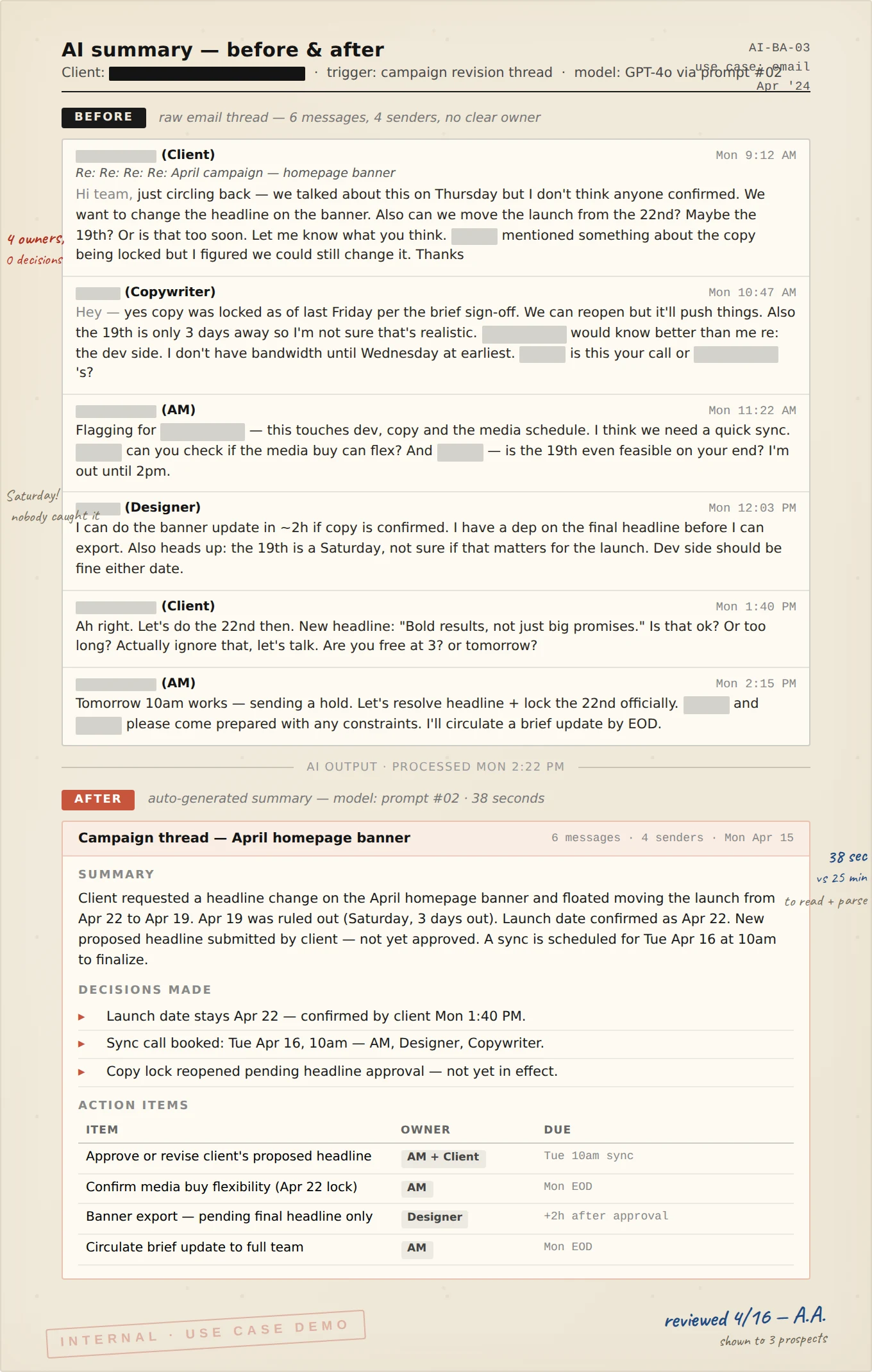
Fifty-two messages down to one page the whole team can act on. The AI is not replacing the conversation — it is capturing what was decided and who owns what, so nothing gets lost in the thread. Drafted in thirty-eight seconds, reviewed by the account lead before it is sent.
Tools I use
Platform-agnostic, outcome-focused
- The major productivity suites and their built-in AI (Microsoft 365, Google Workspace)
- Standalone AI tools selected for the job and the team's actual workflow
- CRM and marketing platforms with AI features (HubSpot, Zoho, others)
- Custom AI agents built on whichever platform is the best fit
I am not tied to any one vendor. If a free or built-in option does the job, we use it. I do not recommend paid tools just to inflate the engagement.
How it works
Readiness check.
I audit the software you already pay for, the tasks eating the most time, and your team's comfort with technology. We identify the two or three places AI will make the biggest difference in your specific business.
Foundation.
AI is only as smart as the information it can see. I organize your documents, clean up your folder structure, and prepare the data the AI will be working with. This is the step everyone skips and then wonders why the AI feels generic.
Configuration and training.
I configure the AI tools, build any custom assistants you need, and train them on your voice, your documents, your SOPs. I test them against real scenarios from your business.
Team rollout.
I run a live session with your team showing them the specific ways to use the AI every day. Not a feature tour, a workflow. I follow up one week later to fix what broke and answer what came up.
The math
A well-configured AI setup saves each team member 30 to 45 minutes a day on writing, searching, summarizing, and answering repeat questions.
For a 10-person team, that is roughly 1,200 hours a year of recovered capacity.
At a $40 per hour loaded cost, that is $48,000 either going back into billable work or going into the owner stopping at 6pm instead of 9pm.
Conservative estimate. The real number is usually higher, but I would rather underpromise and overdeliver than the other way around.
Common questions
Is my data safe?
Depends on how the AI is set up. Consumer-grade tools (free ChatGPT, free Gemini) may use your data for training and are not a fit for most businesses. Business-grade setups keep your data inside your own environment and under your existing permissions. Part of my job is making sure we use the right tier and set permissions up cleanly before any AI touches your data.
Will my team actually use it?
Most teams do not, because nobody showed them the two or three specific workflows that matter for their daily job. The rollout week is the part that makes this stick. If your team is not using it within 30 days, I come back and fix the setup at no additional cost.
What if the technology changes in six months?
It will. AI is moving fast. Everything I build is designed so the workflow survives the tool changing underneath it. If a better model comes out, we swap it in and your team's daily experience does not break.
I do not even know where to start. Is that okay?
That is the most common starting point. The readiness check is specifically designed for it. You do not need to know what AI you want. You just need to know what is frustrating you about how your business runs today.
Find out where AI is actually worth it for your business.
The readiness check is a 45-minute call. You will leave knowing what AI tools you already have access to, what would realistically help your team, and whether this is worth setting up or whether your money is better spent elsewhere. If AI is not the answer, I will tell you.
Book the readiness check